
cs336 note - BPE merge的性能优化实践
1 背景知识
1.1 BPE Tokenizer
BPE Tokenizer全称Byte-Pair Encoding Tokenizer,是语言模型的文本编码部分的算法,其核心思想介于基于Word的方法与基于Character的方法之间,具体为:初始时词表只包含Special tokens以及一个字节的256个值对应的symbol(基于character的方法),训练过程中,统计训练语料中相邻字节串的计数,将最大计数字节串pair合并为一个symbol,并作为新的词加入词表。如此往复。
1.2 BPE Tokenizer Training Process
根据handout,可将训练过程总结如下
词表初始化
先将特殊token放入词表,然后将0-255这些字节值放入词表。
预分词
如果每次都从头到尾去扫描所有文本的邻近pair,那么开销很大,讲义提出的是进行预分词,也就是预先将文本分成多个小的词,统计这些词的出现次数$a$。
在这之后统计邻近pair时,pair的出现次数$b$便可以一次性加上$a$。
同时还能够将符号与词分开。
BPE Merge
一轮merge的过程如下:
- 对每个预分词的词,统计相邻部分的出现次数。如某个词由bytes tuple组成:
('a', 'b', 'a', 'b')(出于篇幅原因,省略''前的bytes标注),统计出相邻pair出现次数dict:('a', 'b'): 2,('b', 'a'): 1 - 选出出现次数最高的pair,并merge。如上述例子,假设对所有词统计完pair出现次数并reduce之后,得出一个出现次数最高的pair:
('a', 'b'),merge过程将所有词出现pair的部分进行合并,如上述某个词整个词一旦出现这个pair的部分都进行合并,变成('ab', 'ab')。对其他词同样进行合并。并将merge行为加入到行为集合merge 'a', 'b',将pair产生的新词加入词表vocab.append('a'+'b') - 回到过程1开启下一轮
- 直到达到所需的merge次数,结束并返回merge行为列表以及训练后的词表
vocab。
处理特殊token
语料中出现文本分割相关词,或一些标记词,除了在词表中加入以外,不需要其他行为。
因此,需要以语料中这些词作为分隔符,分割语料文本,同时将这些特殊token隐藏避免纳入merge过程。
1.3 现有代码
def train_bpe(
    input_path: str | os.PathLike,
    vocab_size: int,
    special_tokens: list[str],
    **kwargs,
) -> tuple[dict[int, bytes], list[tuple[bytes, bytes]]]:
预构建词表
    vocab: dict[int, bytes] = {}
    merge: list[tuple[bytes, bytes]] = []

    # 1. pre construct a vocab
    for i, x in enumerate(special_tokens):
        vocab[i] = x.encode('utf-8')
    for i in range(len(special_tokens), len(special_tokens) + 256):
        vocab[i] = bytes([i - len(special_tokens)])
预分词
def pre_tok(start: int, end: int, input_path: str, special_tokens: list[str]) -> dict[tuple[bytes, ...], int]:
    """
    the each-process processing function of pre-tokenization.
    parallelized reading chunks and processing
    """
    # result: dict[tuple[bytes, ...], int]
    result = defaultdict(int)
    with open(input_path, "rb") as f:
        f.seek(start)
        chunk = f.read(end - start).decode('utf-8', errors="ignore")
        parts = re.split("|".join(map(re.escape, special_tokens)), chunk)

        # pretokenizes each part and count occurrences.
        PAT = r"""'(?:[sdmt]|ll|ve|re)| ?\p{L}+| ?\p{N}+| ?[^\s\p{L}\p{N}]+|\s+(?!\S)|\s+'"""
        for part in parts:
            for pretok in re.finditer(PAT, part):
                pretok = pretok.group()
                key = tuple(bytes([x]) for x in pretok.encode('utf-8'))
                result[key] += 1

    return result

def pre_tokenization(input_path: str | os.PathLike, special_tokens: list[str]) -> dict[tuple[bytes, ...], int]:
    """
    pre splits the corpus by chunks(which is parallel) and run pre-tokenization
    then return each token(the pre tokenized word)'s occurence count dict.
    """
    ## Usage
    with open(input_path, "rb") as f:
        num_processes = 4
        pool = Pool(num_processes)
        all_jobs = []
        boundaries = find_chunk_boundaries(f, num_processes, [x.encode('utf-8') for x in special_tokens])

        for start, end in zip(boundaries[:-1], boundaries[1:]):
            job = pool.apply_async(pre_tok, args=(start, end, input_path, special_tokens,))
            all_jobs.append(job)

        dicts = [job.get() for job in all_jobs]

        pool.close()
        pool.join()

        results = defaultdict(int)

        for d in dicts:
            for k,v in d.items():
                results[k] += v
        return results


# 2. run pretokenization
pretoks: dict[tuple[bytes,...], int] = pre_tokenization(input_path, special_tokens)
merge loop
def count_adjacent_pairs(pretoks: dict[tuple[bytes,...],int]) -> dict[tuple[bytes, bytes], int]:
    """
    count the adj pairs count
    """
    counts = defaultdict(int)
    for k,v in pretoks.items():
        for byte1, byte2 in zip(k, k[1:]):
            counts[(byte1, byte2)] += v
    return counts


def do_merge(pretoks: dict[tuple[bytes,...],int], pair: tuple[bytes, bytes]) -> dict[tuple[bytes,...],int]:
    """
    merge pretoks by pair, and return merged dict
    """
    new_toks = {}
    for key,value in pretoks.items():
        if pair[0] not in key and pair[1] not in key:
            new_toks[key] = value
            continue
        new_key = []

        i = 0
        while i < len(key):
            if i + 1 < len(key) and key[i] == pair[0] and key[i+1] == pair[1]:
                new_key.append(pair[0]+pair[1])
                i += 2
            else:
                new_key.append(key[i])
                i += 1
        new_toks[tuple(new_key)] = value
    return new_toks

# 3. run BPE merge

num_merges = vocab_size - 256 - len(special_tokens)

for i in range(num_merges):
    # 1. count
     counts = count_adjacent_pairs(pretoks)

    # 2. Find the most common pair
    pair = max(counts, key=lambda k: (counts[k], k))
    # 3. add new vocab
    new_vocab_idx = i + 256 + len(special_tokens)
    vocab[new_vocab_idx] = pair[0] + pair[1]

    # 4. do merge
    merge.append(pair)
    pretoks = do_merge(pretoks, pair)

return vocab, merge
完整代码见仓库
2 问题挑战
问题定义
在一轮的merge过程中,每次都需要对所有预分词的词,从头到尾扫描相邻对出现次数,从而重新统计出count进行最高次数pair选择过程。
关键观察
指定某个pair,对其进行merge,其只影响这个pair所在的预分词的词,继续细分的话只影响了这个pair出现位置的左邻居、右邻居以及它本身。
解决方案
根据观察的性质,提出方法:维护邻居pair计数和每个pair所在的位置;每次merge根据存储的pair的位置,在预分词的词列表中,快速找到要更新的词;以及根据其所在位置周围的信息,根据本次merge的变化相应的更新pair计数值。
优点
维护的计数改善了每次循环要重新进行全遍历,而发生更改的计数只有一小部分的问题
索引能够快速找到pair所对应的要更新的词与位置,从而快速更新计数值。
3 实现与评测
3.1 思想一:确定要维护的数据结构
核心方法是维护pairs的计数counts,包含初始化与更新。
因为需要实时更新counts与原语料,所以引入了pairs出现的索引pair_locations
3.2 思想二:确定要改哪些代码
确定到代码只需要修改两处:
- 将loop的count计算提前到loop前,减少到一次计算
- do_merge进行合并与更新的操作
3.3 思想三:merge的合并与更新过程
细节
对于每次找到的要合并的pair,记为(x,y),其左侧邻居bytes为a,右侧邻居bytes为b. 找到pair对应的index集合,当前遍历到集合的某个索引,索引到某个词word1,则进行两种操作:1. 将该词出现该pair的一对相邻bytes合并为一个bytes 2. 相应的更新count 3. 若合并后出现新的相邻pair,则扩充pair_locations
counts更新过程为
- delete阶段
counts[x,y] -= word1.counts

counts[a,x] -= word1.counts

counts[y,b] -= word1.counts
- update阶段
counts[a, xy] += word1.counts

counts[xy, b] += word1.counts
对该pair对应的索引集合中的其他索引所指向的词也应该如此。
尝试
复用预分词阶段产生的pretoks: dict[tuple[bytes,...],int],维护pair_locations: dict[tuple[bytes,bytes], tuple[bytes,...]],以索引pair对应的预分词的词。
弱点
在merge过程中,假设当前正在处理某个词A,而pair_locations中有两个不同的pair1:(x1, y1), pair2: (x2, y2)指向A,那么假设此时为pair1正在更新词,同时更新counts,那么由于dict的缺陷,更新时只能通过删除key并加新key的方式实现,那么经过这一个操作之后,pair2指向的该A作为key去索引pretoks将作为old key失效,也就是经典的悬垂指针问题
思路
可以将弱点总结为:
- 需要将dict变为,方便变更key字段的数据结构。
- locations需要方便的索引到快速变化更新的对象。
同时我们发现:
- 预分词为无序。
所以得出:
- 利用面向对象方法维护快速更新的对象。
- 利用list存储实现快速索引。
因此引出如下实现
3.4 预计算的实现
def count_adjacent_pairs(tokens: list[Token]) -> tuple[dict[tuple[bytes, bytes], int], dict[tuple[bytes, bytes], set[int]]]:
    """
    count the adj pairs count cache, and the locations of pair
    """
    counts = defaultdict(int)
    pair_locations = defaultdict(set[int])
    for index, token in enumerate(tokens):
        for byte1, byte2 in zip(token.symbols, token.symbols[1:]):
            counts[(byte1, byte2)] += token.count
            pair_locations[(byte1, byte2)].add(index) # ensuring each Token_{i} is different(the dict has ensured that)
    return counts, pair_locations
3.5 merge方法的实现
根据如下特殊例子,想到对词内进行流式构造与更新的方法
x y x y merge xy xy
counts:(x,y): 2 (y,x): 1 ->
-
merge第一对xy
-
(y,x)--,(x,y)--->(x,y): 1 -
(xy, x)++->(x,y):1 (xy, x): 1
-
-
操作一结束后的中间结果为
xy x y,此时merge第二对xy-
(x,y)--,(xy, x)-- -
(xy, xy)++
-
即,特例情况下,流式更新方法依然有效。
读者可以尝试推理一下更特殊的例子,如a a a a a a
同时,考虑到在流式更新的时候,new_symbols还没有完全构造,无法将新的pairs的位置更新到pair_locations,因此采用稍微粗粒度的统计方法,在该索引的词完全更新完毕之后,根据count的变化值判断是否有新pair出现,以及进行新位置的索引插入。
此外,可以参考如下作者思考的问答:
Q1. 处理完一个pair之后,删除该pair_locations对应项是否对过程有影响?
没有影响。可以发现,处理完毕一个pair之后,以后的loop不可能再出现处理同一个pair的过程。在本代码实现中为了简便并没有删除对应的pair_locations项。
Q2. 在删除旧pairs过程中,为什么不删除旧的pair_locations对应的该词的index?例如正在处理pairA,而pairA对应的第一个byte跟左边邻居byte所组成的left_adj,要拿去减counts,那pair_locations[left_adj]里面一定会有这个index
在本代码的实现中,可以发现处于一种较细粒度,但不是非常细粒度。本实现为了方便,只记录了对于token全表索引,此实现基于一种假设,即token的symbol不会太长,在token中重新寻找该pair的复杂度不会太高。属于一种trade-off
证明
考虑一种情况:
本token包含left_adj与pairA组成的三元字节组,同时包含只有left_adj,但没有与pairA组合的字节组。第二种分类下,本次对pairA的处理并不会将counts[left_adj]减为0,那么当未来处理到这个left_adj所对应的pair时,如果先前处理pairA时,将left_adj对应index删除,将在处理left_adj对应合并时无法找到对应的tokens索引,出现索引丢失问题。
而不删除索引也不会出现正确性的问题,因为已经更新了tokens的symbol和counts,在处理到left_adj的merge的时候,已经更新的token和counts不会有多计数或者少计数的问题。
考虑另一种情况:
token并不包含上述情况中两种分类,只有一种分类。那么合并pairA时,旧的left_adj的counts已经为0,且本token不再包含left_adj这个pair,在下次merge到这个pair的时候,无法找到对应pair,于是正确的略过了merge。于是对当前实现可以有改进方案比如判断counts[pair]是否已经为0。
细粒度方法介绍:细粒度控制pair索引
fine-grained方法的索引应该同时记录pair对于token全表的索引、以及pair对于token本身的token内索引。然后进行细粒度插入与删除。这种实现可以满足该问题对细粒度索引控制的要求。不过本实现为了简便并未采用。
def do_merge(tokens: list[Token], pair: tuple[bytes, bytes], pair_locations: dict[tuple[bytes,bytes], set[int]], counts: dict[tuple[bytes, bytes], int]):
    """
        1. locate where pair exists in tokens by pair_locations
        2. merge the pair in these tokens, update tokens token by token
        3. update counts by the merge process, and update pair_locations by the merge process
    """
    for idx in pair_locations[pair]:
        token_count = tokens[idx].count
        token_symbols = tokens[idx].symbols
        new_symbols = []
        i = 0
        counts_changes = defaultdict(int)
        while i < len(token_symbols):
            if i + 1 < len(token_symbols) and token_symbols[i] == pair[0] and token_symbols[i+1] == pair[1]:

                # count change is linear.
                # decrease old adjacent neighburing counts.
                counts_changes[pair] -= 1 * token_count
                if i > 0:
                    left_adj = (new_symbols[-1], token_symbols[i])
                    counts_changes[left_adj] -= 1 * token_count
                if i + 2 < len(token_symbols):
                    right_adj = (token_symbols[i+1], token_symbols[i+2])
                    counts_changes[right_adj] -= 1 * token_count

                new_symbols.append(pair[0]+pair[1]) # pair[0] is key[i], pair[1] is key[i+1]

                # increase new adjacent neighburing counts. notice that this is linear processing
                # so using new-old bounding, keeps the invariant of loop
                if len(new_symbols) > 1:
                    # the invariant is that, tail is the just merged pair
                    left_adj = (new_symbols[-2], new_symbols[-1])
                    counts_changes[left_adj] += 1 * token_count
                if i + 2 < len(token_symbols):
                    # the invariant is that, i + 2 is the linear process's right neighbor
                    right_adj = (new_symbols[-1], token_symbols[i+2])
                    counts_changes[right_adj] += 1 * token_count
                i += 2
            else:
                new_symbols.append(token_symbols[i])
                i += 1
        tokens[idx].symbols = new_symbols
        # the new adjacent counts, finally added to locations.
        # and update variation to counts
        for k, v in counts_changes.items():
            counts[k] += v
            if v > 0:
                pair_locations[k].add(idx)
3.6 评测
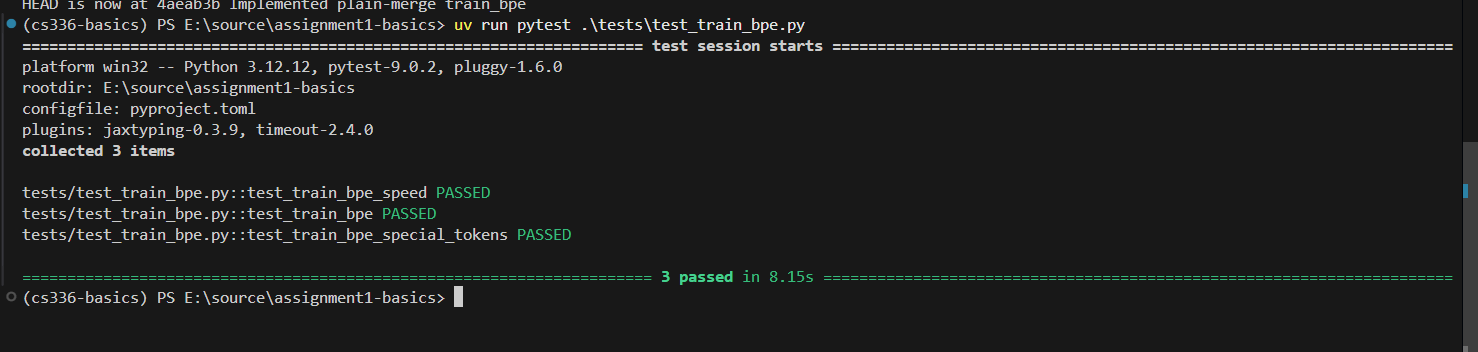
使用cs336的test脚本进行初步测试。基于corpus.en(test_train_bpe)/tinystories_sample_5M.txt(test_train_bpe_special_tokens)
旧版8.15秒,性能优化版本1.43秒。

4 总结
本实践报告介绍了Language Modeling课程中Tokenizer作为自然语言与模型理解之间转化桥梁的作用,重点关注于BPE Tokenizer的训练过程性能优化,针对朴素每轮merge重扫描相邻对的低效冗余问题,提出并实现缓存相邻pair、针对性更新循环过程所基于的当前merge词语料库的数据结构与算法,并由这个需求提出了pair实时索引的数据结构与算法,该优化将BPE Tokenizer在测试集上的训练时间从8.15s降低至1.43s,显著加快了训练过程。
同时,文中还分析了采用更细粒度的实现的可能性,为后人提供一定的优化参考。
5 参考文献
[1] CS336 Staff. cs336_assignment1_basics[EB/OL]. (2026-03-30) [2026-07-10]. https://github.com/stanford-cs336/assignment1-basics
[2] CME 295 Staff. Lecture1: Transformer slides[EB/OL]. (2025-09-26) [2026-07-10]. https://cme295.stanford.edu/slides/fall25-cme295-lecture1.pdf
附录A. lazy-update of counts & location
def do_merge(tokens: list[Token], pair: tuple[bytes, bytes], pair_locations: dict[tuple[bytes,bytes], set[int]], counts: dict[tuple[bytes, bytes], int]):
    """
        1. locate where pair exists in tokens by pair_locations
        2. merge the pair in these tokens, update tokens token by token
        3. update counts by the merge process, and update pair_locations by the merge process
    """
    for idx in pair_locations[pair]:
        token_count = tokens[idx].count
        token_symbols = tokens[idx].symbols
        new_key = []
        i = 0

        while i < len(token_symbols):
            if i + 1 < len(token_symbols) and token_symbols[i] == pair[0] and token_symbols[i+1] == pair[1]:
                new_key.append(pair[0]+pair[1]) # pair[0] is key[i], pair[1] is key[i+1]

                # count change is linear.
                # decrease old adjacent neighburing counts.
                counts[pair] -= 1 * token_count
                if i > 0:
                    left_adj = (token_symbols[i-1], token_symbols[i])
                    counts[left_adj] -= 1 * token_count
                if i + 2 < len(token_symbols):
                    right_adj = (token_symbols[i+1], token_symbols[i+2])
                    counts[right_adj] -= 1 * token_count

                # increase new adjacent neighburing counts. notice that this is linear processing
                # so using new-old bounding, keeps the invariant of loop
                if len(new_key) > 1:
                    # the invariant is that, tail is the just merged pair
                    left_adj = (new_key[-2], new_key[-1])
                    counts[left_adj] += 1 * token_count
                if i + 2 < len(token_symbols):
                    # the invariant is that, i + 2 is the linear process's right neighbor
                    right_adj = (new_key[-1], token_symbols[i+2])
                    counts[right_adj] += 1 * token_count
                i += 2
            else:
                new_key.append(token_symbols[i])
                i += 1
像这个的问题就是,我无法知道该什么时候更改pair_locations,因为有些中间locations根本不必要插入,频繁插入和删除反而有点麻烦
改进方法是变为coarse-grained的记录,只记录整个token merge前,merge后,对locations的变化和counts的变化,在token merge之后的最后才进行更新和统计。
博客链接:https://zcxha.github.io/blog/post/cs336%20note%201%20-%20BPE%20merge%20%E7%9A%84%E6%80%A7%E8%83%BD%E4%BC%98%E5%8C%96%E5%AE%9E%E8%B7%B5/
comment 评论区
star_outline 咱快来抢个沙发吧!